I recently found out that for a brief period uranium oxide was added to glass to give it a nice yellow / green color. This was mostly in the 1930s and 1940s. This glass was used in plates meant for food. It was a nice complement to the lead paint and asbestos. Given that the uranium is tightly bound up in the glass, I doubt you would absorb much in regular usage, but it is clearly a bad idea.
Naturally that meant I had to have it. One quick trip to my favorite website (ebay) and I was the proud owner of a ~15cm diameter uranium glass plate. One of the neat things about this glass is that it glows a bright green under UV light. This gave me an idea I could not resist.
I have in the past made a geiger counter, a relatively cheap and easy project given the availability of geiger tubes on ebay and the simple nature of the devices. What occurred to me was that I could make a minimalist geiger counter, but rather than connecting a small speaker, I could connect UV LEDs, the mount it to the plate and display it. It random intervals the geiger counter would be set off by emissions from the plate, and then the whole plate would briefly flash that nice eerie green that caught my eye in the first place.
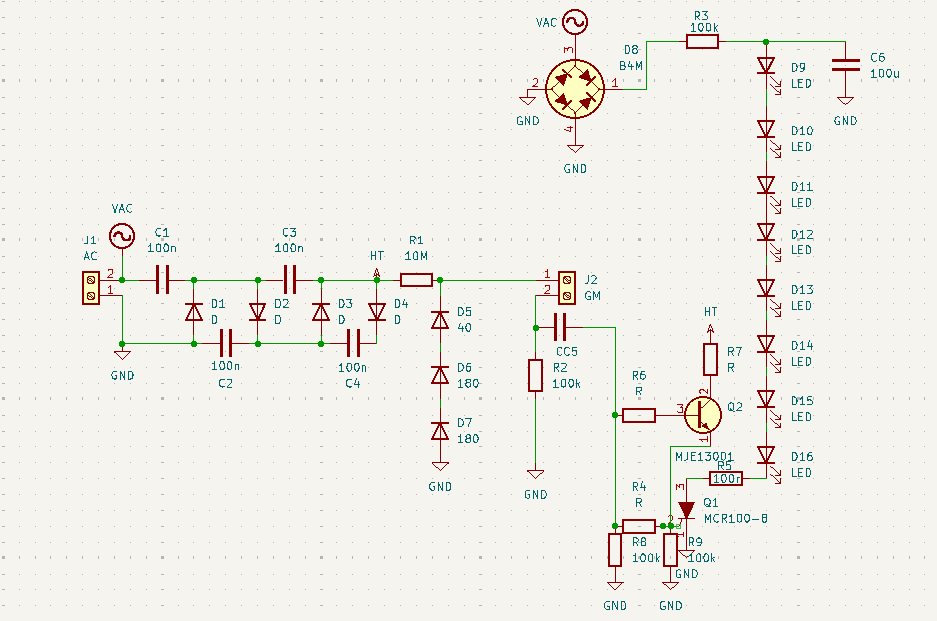
The device schematic is very simple:
Since this won’t be in any way mobile or accessible to people I powered the tube with (non-isolated) mains through a voltage multiplier, doing away with the DC/DC converter that would be needed in a practical hand held geiger counter (which would need to be safe and mobile).
Once radiation strikes the tube it will conduct VERY briefly and create a short pulse. In order to directly be noticeable by a human the pulse needs to be made longer. I did not want to bother creating a low voltage section to run a micro controller or 555 timer so I used all high voltage components. A NPN BJT amplifies the signal out of the tube and drives the gate of a small SCR. SCRs are usually used in AC power switching, but have a useful latching behavior that can be used here. When an SCR is triggered in conducts until the current drops below the holding current of the device. In an AC application this will be the 0 crossing of the sine wave. But here (given that R3 does not pass enough current to keep the SCR on) that is when C6 is fully discharged via R5 and the LEDs. This creates a pulse of light much longer than the input trigger signal.
I had to play with the values of R5 and C6 to get the effect to my liking. The light is on for about 1s and the fact that it fades gently is to my liking as a visual effect. I initially just soldered the LEDs onto the PCB however this did not make nice striking glow. When just pointed at the plate a fair amount of visible blue / violet got through the plate. The green glow was very localized and a bit swamped out by the blue. I had to mount the LEDs around the rim of the plate pointing towards the center of the plate to get the nice green glow I wanted. This resulted in 3D printed brackets at intervals along the rim of the plate and wires leading the the board. I decided this is a feature not a bug; it is techno art after all.
I also had a surprising failure of the SI3BG USSR era geiger tube I had lying around. I drove myself crazy for about 3 hours trying to figure out what was wrong with such a simple circuit, before I realized the tube was bad. As far as I can tell it just went off in storage. Surprising, but maybe it should not be, it was 40+ year old overstock. These soviet era tubes used to be cheap and very available on ebay. And they are still around but there is clearly not as many as there once was and they are not as cheap as they used to be even if they are still within reason. However I found that you can now get new Chinese made tubes on Aliexpress (or your choice of discount junk supplier) for a reasonable price. It was slightly more than the cheapest SI3BG tube on ebay, but had local stock with fast delivery. I decided to give it a go and it was a good deal. It was a nice a small tube and was more sensitive than my SI3BG ever was. The SI3BG tube was really meant as an indicator of wether you should be running away or not, not as a scientific instrument.
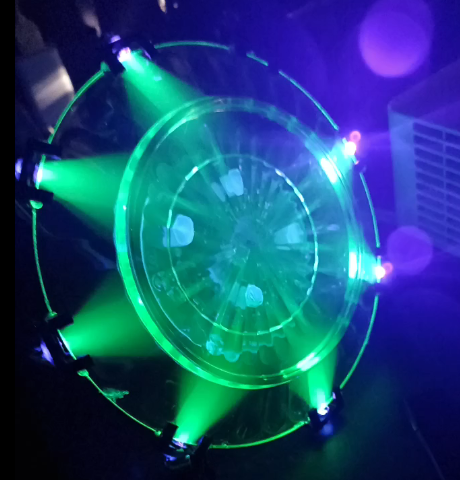
In the end it was a fun little project with a pleasing look. It will be a permanent fixture on my mantle piece. As I took the photo for this post I noted one of the LEDs is not lighting, I will have to go fix that now...