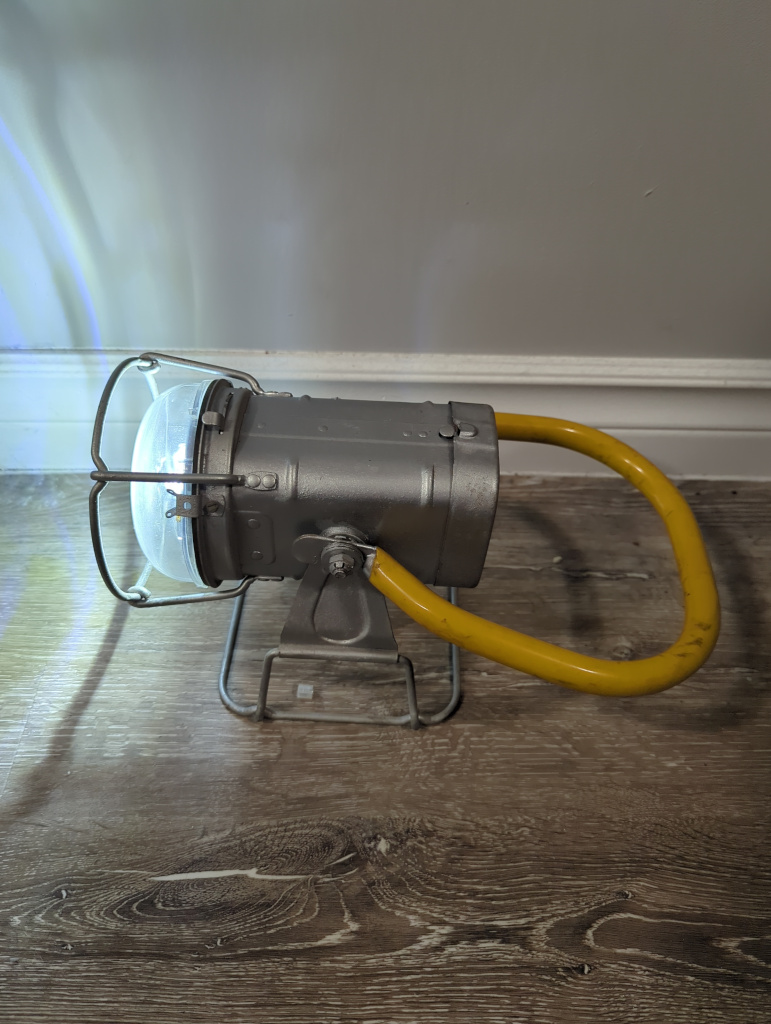
I like vintage stuff. It is interesting, well made (usually), and often easily fixed and put back into service. Also, if you find the right place, it can be very cheap. I picked up a pair of mining lights made by “Justrite” for a few bucks at a flea market. Functionally, these are just old school work lights. The “mining” comes from a rating for use in environments with explosive gasses (non sparking), and possibly the fact that it has two bulbs. Having two bulbs provides redundancy against one burning out, and you can replace the bad bulb while the other is still providing light. This matters quite a bit if you are underground with limited options for light. The electronics are as simple as you would expect. Two small incandescent bulbs are connected to a lever and pulled across some contacts. It can be off, powering one, or both bulbs. This provides adjustable brightness as well as the ability to replace a bulb while the light is still working.
I really like the style of the light. the body of the light can move independently of the yellow handle and the cage structure, which can act as a stand. It can easily be carried, placed on a flat surface with the light shinning at any angle and or hung up very easily. I like it more than most of the modern work lights I own. I wonder when this pattern of light is no longer made. It is slightly more complex, but this whole thing is simple to make. It is just sheet metal and round stock, nothing we can’t mass produce very cheaply these days.
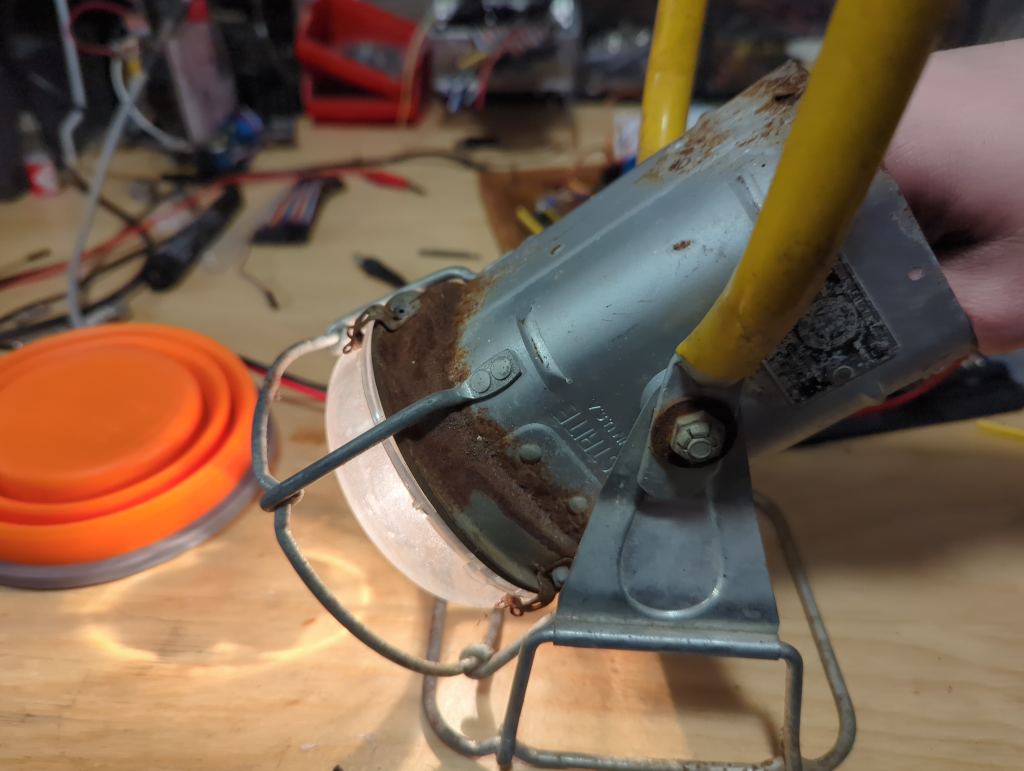
I decided to fix these up for myself. The lights worked, a testament to simple design and good manufacturing, but some modern things are better. For example LEDs literally outshine the incandescent bulbs fitted in this thing. Whatever long obsolete battery this was meant to operate this is nowhere to be found. And the one thing I found on my modern work lights that added something was magnets to allow the light to stick to steel.
I removed the rust, repainted it, fitted some 18650s, installed two magnets from a 3.5 HDD in the body, and fit some LED bulbs with the same bases as the original.
This is now a great little unit for my shop. However the most powerful LEDs I could get with bases that match the original bulb were not as powerful as I would like. The unit is way brighter than it was before, but dimer than most work lights. I left the bases and switch mechanism intact as I wanted it be as authentic as possible while making it useful, I wanted to restore it, more than modify it.
However the second unit was more corroded, so I decided to tear out the switch mechanism, and use a modern switch with a COB LED array that was much brighter than the LED bulbs I put in the first one, it was in fact pulled from a cheap work lamp which no longer held a charge. I hate the waste of non-user replaceable batteries.
I wanted to end this with a comparison of the different bulbs, but the difference in brightness does not show properly in a regular photo. Overall I like these little lights, they are an interesting piece of history and can still be useful.